I Couldn't Walk Into a Room Without Wondering How People Saw Me — Here's What I Eventually Understood About That, and What I Did About It

Someone uploads a group photo.
You open it.
Your eyes scan the image — and within a few seconds, you find yourself. Not the memory. Not your friends. Not the moment.
You.
Then comes the judgment.
"Why do I look like that?"
"My smile looks weird."
"Everyone else looks so much better."
"I wish I hadn't been in the picture."
A photo that was supposed to capture something good suddenly becomes an opportunity to feel bad about yourself.
If this is you — you are not alone. And you are not vain. And you are not broken.
But something is happening underneath this habit that most people never stop to examine.
Over time, these small moments add up. You begin avoiding photos. You become more self-conscious in social situations. You compare yourself to others more often. You spend more energy worrying about how you look than actually living the moments you are in.
And here is what makes it harder.
When other people look at the same photo — they are usually doing exactly what you are doing. Searching for themselves. Most people are far less focused on your appearance than you imagine. But the drop you feel? That is very real.
I know this because I lived it.
"There was a time I couldn't walk into a room without wondering how people saw me. Not because anyone said anything cruel. Because I had developed the habit of measuring my worth by my appearance."

My name is Samuel Olarinde.
I am not a therapist. I am not a certified coach. I am someone who spent years inside this problem — living with it quietly, investing in understanding it, and eventually coming out the other side with enough clarity to write about it.
A photo could ruin my mood.
A mirror could change how confident I felt walking into a conversation.
Seeing someone who seemed to look "better" than me could trigger a comparison spiral without me even noticing it had started.
I was not walking around in constant misery. It was subtler than that. It was the background noise of someone who had quietly tied their self-worth to their appearance — and spent a significant part of every social situation managing that connection.
I tried telling myself it didn't matter. I tried focusing on other things.
Because the problem was not a lack of positive thinking. The problem was a habit — a deeply ingrained pattern of using my own image as a measuring stick for my worth.
Habits do not respond to intention alone. They require understanding. Then deliberate, consistent work to replace them.
That understanding came through real investment — a coaching program that cost ₦47,900 and gave me the psychological insight that led me to research this subject further. That research is what eventually became this guide. The coaching pointed the direction. The days of reading, reflecting, and structuring the material into something genuinely useful — that is what brought it into its final form.
I wrote it because I know I am not the only one who has carried this quietly.
The Real Problem Is Not the Photo
Here is what most people assume: the problem is their appearance.
So they focus on their appearance. Better angles. Better lighting. Filters. Avoiding cameras altogether. Losing weight. Fixing the thing they think is wrong.
And sometimes those things help — temporarily. But the pattern comes back. Because the pattern was never really about appearance.
The deeper issue is the habit of attaching self-worth to how we think we look.
When your value becomes connected to your appearance, every photo becomes a test. Every image becomes evidence. Every imperfect angle feels like confirmation of something you already feared about yourself.
Here is what is actually happening in those moments:
The brain constantly scans for signs of acceptance or rejection. Because appearance is one of the first things people notice, many people unconsciously attach their worth to how they look. The result is a cycle: good photo, good mood. Bad photo, bad mood. That is emotional instability built on a foundation that was never meant to carry that weight.
When you search for yourself in a group photo, you are not being vain. You are being human. You want to know how you are perceived. Whether you fit in. Whether you look acceptable. Whether you belong.
The problem is not the search. The problem is what happens next — when a single image becomes the answer to questions that a photograph was never equipped to answer.
A camera captures appearance. It cannot capture character, integrity, wisdom, kindness, or courage. It captures a moment. One angle. One expression. One fraction of a second. And yet for many people, that fraction of a second is treated as a verdict.
The goal is not to love every photo. The goal is to stop letting a single image determine how you feel about yourself.
"The question was never: why do I look like this? The real question was: why does a photograph have this much power over how I feel about myself?"
What Changed — And What It Actually Felt Like
The shift did not happen dramatically. There was no single moment where everything clicked and I suddenly loved every photo of myself.
It was quieter than that.
It started with understanding. When I genuinely grasped what was driving the habit — not just intellectually, but in a way that I could see it happening in real time — something changed in how I related to it.
I could watch the reflex start. I could notice the search beginning, notice the judgment forming, and make a different choice about what to do next.
Then, with consistent practice, the reflex started to slow down on its own.
Photos stopped being tests. They became pictures again.
The comparison habit — measuring myself against the people around me — started losing its grip. Not because I started thinking I looked better. But because I stopped needing to run the comparison at all.
I began showing up at events differently. Less energy spent managing my imagined appearance. More attention on what was actually happening — the conversation, the people, the moment.
And the confidence that came from that was different from anything I had tried to build before. It was not the kind that depends on looking a certain way. It was the kind that stays even when the photo is imperfect.
"I stopped checking photos like someone reviewing evidence against themselves. I started looking at them like someone remembering something good."
How This Guide Came to Exist
This guide did not begin as a publishing project. It grew gradually — out of the process of understanding the problem myself and wanting to make that understanding available to others in a structured, useful form.
The coaching program gave me a starting point. The research that followed — the reading, the reflection, the work of organising these ideas into something that could genuinely help a reader — took several days to bring into its final shape.
As it developed, I shared it with a few people for review — to test whether the ideas landed clearly, whether the exercises were practical, and whether the language made sense to someone encountering these concepts for the first time.
They weren't just reviewing the guide. They were connecting with experiences that felt surprisingly familiar.
That feedback confirmed what I already suspected: this pattern is far more common than people admit. And the understanding that helps with it is not widely available in one place, in plain language, aimed directly at the habit itself.
That is what this guide is.
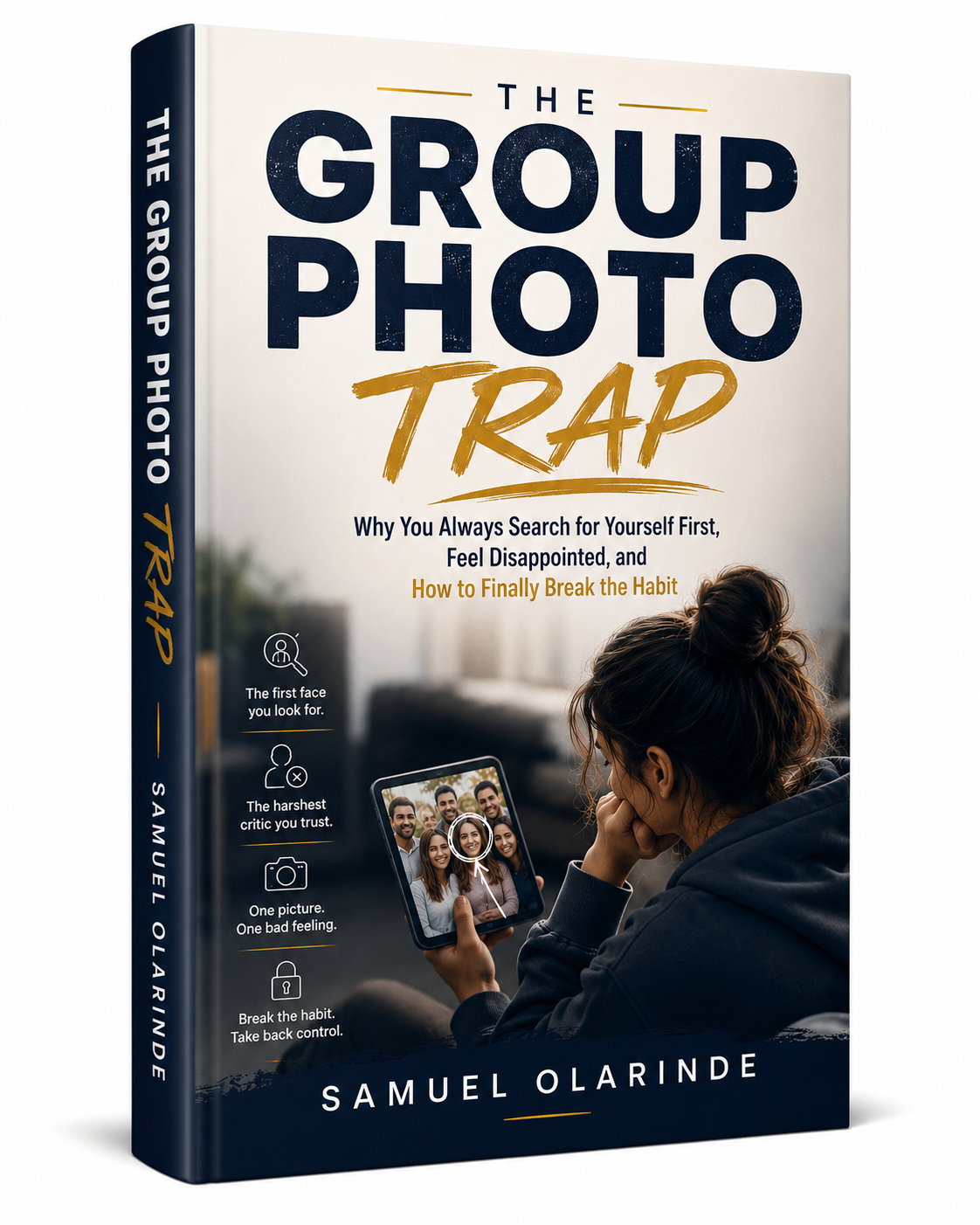
Everything I understood — through living this, investing in understanding it, and working through it — written in plain language, so you can begin applying it today.
This guide is not about pretending appearance doesn't matter. It is not about forcing positivity or convincing yourself to love every photo ever taken of you. It is about understanding why photographs have had this much power over how you feel about yourself — and building the kind of confidence that does not depend on them.
-
Introduction — It's Never Really About the Photo
Why a photograph becomes an emotional confidence test — and what this guide is actually designed to do for you. -
Chapter 1 — Why You Always Search for Yourself First
The hidden need for acceptance that drives the search. Why appearance feels so important. How confidence acts as emotional protection — and what happens when it is absent. Includes a reflection exercise to help you identify what you are actually looking for when you open a group photo. -
Chapter 2 — Why You Feel Disappointed
The comparison trap, and why it guarantees dissatisfaction. The flaw-finding habit. How social media has quietly raised the standard of comparison to something no unedited photograph can meet. Includes a reflection exercise on the gap between what you criticise and what others actually value in you. -
Chapter 3 — The Truth About Identity
What a camera can and cannot capture. The difference between surface and substance. Why your worth and your appearance are not the same thing — and what actually creates lasting impact. Includes a reflection exercise to surface the qualities in you that no photograph could show. -
Chapter 4 — Building Confidence Beyond Appearance
Internal validation versus external validation. How to build confidence that holds regardless of what a photo looks like — and what that kind of confidence is actually built from, day by day. -
Chapter 5 — How to Finally Break the Habit
Five practical steps: stop zooming in, catch negative self-talk, focus on the memory, practise self-acceptance, and build a bigger identity. Concrete actions you can apply the next time a group photo appears. -
Conclusion — Walk Into Freedom
The day you stop measuring your worth by your appearance is the day you begin to experience true freedom. A final framing of what that actually looks like going forward.
A quick-reference checklist to use the next time a group photo appears. Eight practical reminders to apply before you open the image:
- Remember that a photo captures a moment, not your worth.
- Focus on the memory before focusing on yourself.
- Avoid comparing yourself to others.
- Look at the whole picture before zooming in.
- Challenge negative self-talk.
- Ask: "What was special about this moment?"
- Remember that your value extends beyond appearance.
- Move on without repeatedly analysing the photo.
No equipment needed. No special tools. Everything in this guide can be applied today, wherever you are, with nothing more than your attention and your willingness to look honestly at the habit.
Compare That to What You Have Already Tried
- Avoiding cameras and group photos: Costs nothing financially — but the anxiety around photos stays exactly where it is. You are managing the symptom, not the cause.
- Filters and editing apps: They change how the output looks but leave the internal habit of self-judgment completely untouched. The next unedited photo triggers the same response.
- General confidence content and advice: Valuable broadly, but rarely designed to address this specific pattern — the habit of tying self-worth to appearance and using photographs as the measuring point.
- Social media detoxes: Remove the trigger temporarily. The moment you return, the pattern resumes exactly where it left off — because the habit was never addressed, only avoided.
- Telling yourself it doesn't matter: Completely free. And for most people, completely ineffective against a habit that runs faster than conscious thought.
- The real cost — the one with no price tag: the events you attended while only half present. The photos that do not exist because you removed yourself from the frame. The confidence that was available to you but never fully built.
How Much Does This Guide Cost?
Let me be straightforward about what went into building this.
The foundation came from a coaching program I invested ₦47,900 in — one that pointed me toward the psychology behind this pattern and prompted the deeper research that followed. That research, and the days of reading, reflecting, and structuring everything into a form that could genuinely serve a reader, is what produced the guide you see here.
Given that, ₦2,500 is a fair and honest price for what is inside.
Once You Click That Button, Here Is What Happens
- You are taken to the secure payment page on Selar.co. The process takes under two minutes.
- You complete your payment with your card, bank transfer, or USSD — whichever works for you.
- You are redirected to a thank you page where your guide is available to download immediately.
Right Now, You Have Two Choices
If You Do Nothing
- The next group photo comes out. You search for yourself. The judgment runs. The familiar drop happens.
- You continue spending part of every social event managing your imagined appearance instead of being present in it.
- The comparison habit continues — every photo another round of measuring yourself against others.
- The confidence you are capable of building stays just out of reach, quietly undermined by a habit you never addressed at the root.
- A year from now, the pattern is a year older. And a year more familiar.
If You Get The Guide Today
- You understand — for the first time — exactly what has been driving this habit and why. That understanding alone changes your relationship with it.
- You work through the reflection exercises and practical steps designed specifically for this pattern.
- The comparison reflex starts to lose its grip — not because you start thinking you look better, but because you stop needing to run the comparison.
- You begin building confidence that is not dependent on appearance — the kind that holds even when the photo is unflattering.
- You show up at events more fully. More present. Less managed.
✦ A Note From Samuel
If you have any questions or concerns after purchasing, feel free to reach out. I am committed to providing value and helping readers get the most from this guide.
One Last Thing…
Picture yourself one month from today.
A group photo comes out. You open it. And your first thought is about the memory — about who was laughing, what was said, what the moment actually felt like.
Will you be in more photos — not because you forced yourself, but because you stopped dreading them?
Will you attend events with more of your attention on what is actually happening, instead of on how you are coming across?
Will you have built the kind of confidence that does not depend on an angle or a filter or a comparison to the person standing next to you?
Will you be someone who looks at a group photo and sees a memory — not a verdict?
Now picture yourself one month from today if you close this page.
The next photo comes. You search. You find yourself. The judgment runs. Everything continues exactly as it has.
The difference between those two versions of you is a decision you make in the next sixty seconds.
I'M READY TO BREAK THE PATTERNIf you have read this far and you are still hesitating —
Ask yourself honestly: what is the hesitation really about?
It is probably not the ₦2,500. You have likely spent more than that — in time, in energy, in half-present moments at events — on a problem you never fully addressed.
The hesitation is more likely the small voice that says: what if this doesn't work for me? What if this is just how I am?
That voice is the habit talking. The same pattern that uses your image as evidence against your worth is now using your doubt as evidence against your capacity to change.
You do not have to keep running that pattern.
Stop hesitating. Choose yourself.
YES — I'M CHOOSING MYSELF TODAYP.S. — If you have any questions after purchasing, I am reachable at samtee4jesus@gmail.com. I read every message personally and am committed to making sure this guide is genuinely useful to you.
P.P.S. — The guide is available now for ₦2,500 — a one-time payment. Instant download after payment. No waiting, no shipping, no complications. You can begin reading within minutes of completing your purchase.
P.P.P.S. — Every day you wait is another event where part of you is somewhere else. Another photo you will scan for something to criticise. Another moment of confidence left unbuilt. The guide is ready. Start today.